Male vs Female Blue Crab: Key Differences Explained
Male vs Female Blue Crab: Key Differences Explained
Stand over a bushel of blue crabs at a Chesapeake dock or lean across a Gulf Coast seafood counter and someone will eventually point at a crab and ask: is that a male or a female? Most people shrug and guess. A few say they can tell, but when pressed, they can't explain exactly how. The good news is that identifying the sex of a blue crab is quick work once you know what you're looking for, experienced crabbers do it in seconds, and the signals are hiding in plain sight on the belly of every crab you pick up.
This guide covers the three visual markers that matter: apron shape, claw color, and body size. It also gets into the honest story on taste and meat differences, explains which crab belongs in which dish, and breaks down the legal rules you need to know before you harvest or buy. Blue Crab Guide by Theron McCarthy offers a visual identification library covering apron stages and molt conditions, worth bookmarking as a follow-up, but start here for the fundamentals.
The apron flip: the single most reliable way to sex a blue crab
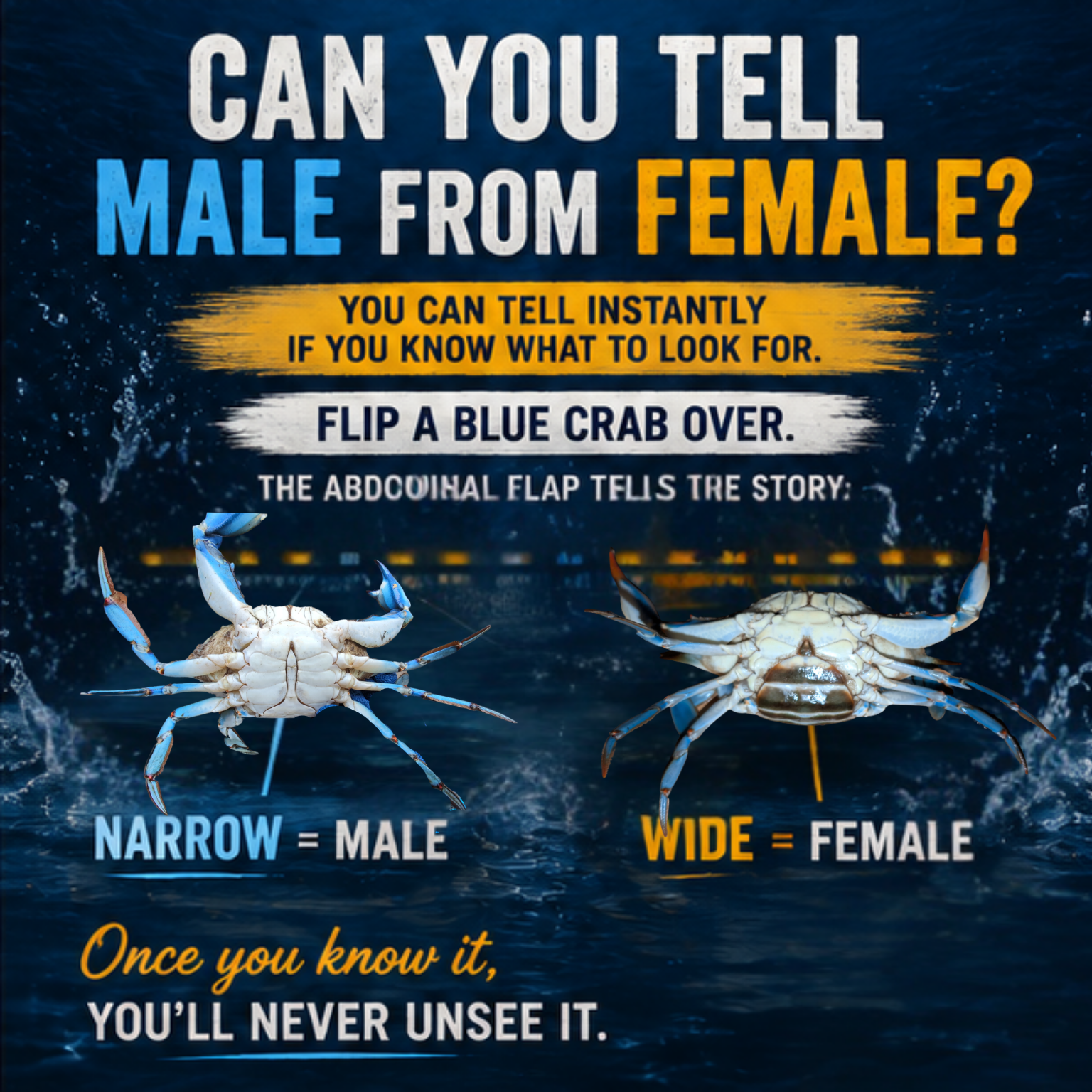
Every other identification method is secondary to this one. Flip the crab over and read the underside. The apron is the abdomen flap on the ventral side of the crab, sitting along the center of the belly. It's visible the moment you turn the crab over and requires no tools, no measuring tape, and no guesswork.
What the apron actually is and where to find it
The apron is a segmented flap tucked against the underside of the crab's shell. In biological terms, it's the folded abdomen. In practical terms, it's the feature that tells you everything you need to know about sex with one glance. You'll see it immediately when you flip any blue crab onto its back.
Male apron shape vs. female apron shape
A male blue crab's apron is narrow, elongated, and pointed at the tip, shaped like an inverted T. Chesapeake crabbers have compared it to the Washington Monument for generations, and that comparison holds up well as a memory shortcut. A mature female's apron is broad, rounded, and dome-shaped, much like the Capitol dome in the same D.C. landmark analogy. The apron shape is the single most reliable indicator of sex, and experienced crabbers use it as their primary test every time.
Immature females look different from mature ones
Here's where a lot of people make mistakes. A young, sexually immature female, called a "sally" by commercial crabbers, has a triangular or V-shaped apron that sits somewhere between the narrow male shape and the full rounded dome. If you only know to look for "pointed vs. dome," you'll misidentify sallies as males fairly often. The broad, rounded dome apron develops fully only after sexual maturity, so a sally won't show you the classic sook shape. Photo comparisons and side-by-side references for apron stages, including those available through authoritative identification guides and state fisheries resources, make sorting this out in the field much faster than relying on written descriptions alone.
Claw color, body size, and the local names every crabber uses
Once you've read the apron, claw color is the fastest confirming signal. It takes a second look and locks in what the apron already told you. Body size adds another layer, though it works better as supporting evidence than as a standalone test.
How to read claw color: blue tips vs. red tips
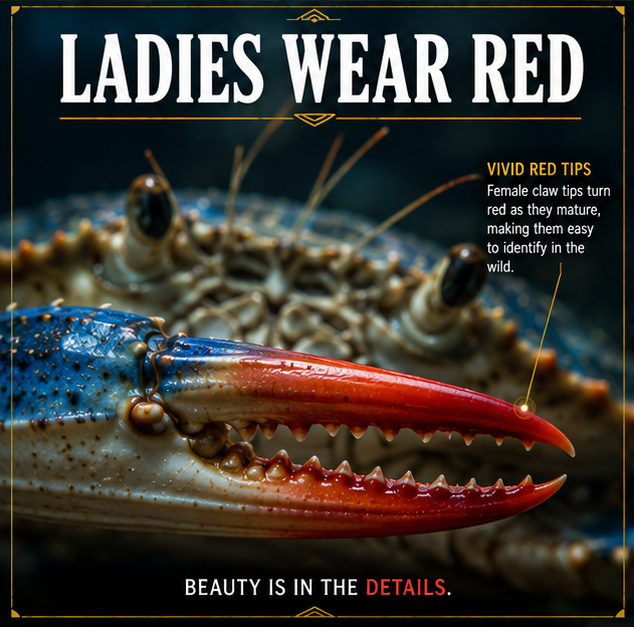
Male blue crabs carry claws that are blue or blue with orange-reddish accents at the tips. Female claws are tipped in bright red, sometimes described as orange-red, and crabbers along the Chesapeake and Gulf Coast have long called them "painted fingernails" as a visual shorthand. It's an accurate description. Claw color is helpful, but worth treating as a secondary signal rather than a primary one. Coloring can vary with age, water chemistry, or claw regeneration after a molt, so a freshly regrown claw may not show the expected color pattern.
Body and claw size: do males really run bigger?
Generally, yes. Adult males, known as jimmies, tend to have larger, broader bodies and thicker claws than females at the same age. That size difference translates directly to meat yield at the table, which is one reason jimmies dominate the market for whole-crab steaming and boiling. The caveat is that size varies considerably within each sex based on season, molt stage, and individual age, so size alone can't reliably confirm sex. Use it to reinforce what the apron already showed you, not as a replacement for it.
Jimmy, sook, and sally: the trade names that actually matter
These three terms show up at seafood markets, on commercial docks, and in state regulations. A jimmy is an adult male. A sook is a sexually mature adult female. A sally is an immature female, not yet sexually mature. Knowing these names matters beyond the dock: state regulations frequently reference them directly, and seafood vendors use them to describe what they're selling. When someone at a market tells you they've got number-one jimmies, they mean large, fully-filled adult males ready for steaming.
Taste, texture, and meat yield: what's actually true
Now that you can confidently identify the crab in front of you, the natural next question is whether sex actually affects how it tastes or how much meat you get. The honest answer is more nuanced than most seafood writing admits.
The flakier vs. denser debate
The most commonly reported perception is that male crab meat is flakier and firmer, while female meat is denser, sometimes sweeter, and occasionally described as richer. You'll find this claim in nearly every regional seafood guide from Baltimore to the bayou, and crabbers repeat it as received wisdom. What's worth noting clearly: it has not been validated by controlled sensory studies. Many crab eaters with decades of experience report no meaningful flavor distinction at all, and the science isn't there to settle it. Treat the flakier-vs-denser pattern as a widely shared perception, not a proven fact.
What actually affects meat quality more than sex
Molt stage, season, and post-harvest handling consistently have a larger impact on texture and flavor than the sex of the crab. A recently molted male can be soft and light with less developed meat, while a well-filled female in peak late-summer condition will carry dense, rich meat. Water temperature, crab diet, and how quickly the crab was chilled after harvest all matter too. If you're making buying decisions based on meat quality, ask about the molt stage and when the crabs were caught before worrying about sex.
The roe factor: why it changes everything for female crabs
The genuine, non-debatable culinary distinction unique to female crabs is roe. Females carrying developed roe produce a concentrated, creamy, intensely savory flavor that has no equivalent in male crabs. Roe is the real variable that separates sooks from jimmies in the kitchen, and it's the reason certain female crabs command a market premium. This isn't regional folklore; it's a straightforward culinary reality that experienced cooks and traditional recipes account for deliberately.
How sex changes what you cook and what you pay
Knowing the difference between a jimmy and a sook should change how you shop and how you plan a meal. The right crab depends on what you're cooking, not just what's available at the counter.
When a jimmy is the right call
Males are the standard choice for steaming, boiling, and any whole-crab presentation. Their larger bodies, thicker claws, and firmer meat hold up well to high heat and make picking easier. If you're hosting a backyard boil or steaming a dozen crabs with Old Bay and apple cider vinegar, you're almost certainly reaching for jimmies. Number-one jimmies are the gold standard for this, and most Chesapeake and Gulf Coast seafood markets price them accordingly.
When a sook earns its place at the table
Sooks are better suited to crab cakes, soups, bisques, and preparations where the meat gets picked, flaked, or blended into a larger dish. When roe is present, it adds a layer of richness that transforms she-crab soup into something genuinely complex and worth seeking out. Gulf Coast gumbo and Chesapeake she-crab soup both have long traditions of calling specifically for sooks, and those traditions exist for good reason. If you're after roe, ask your fishmonger directly; not every female in the market will be carrying a developed egg mass.
Market price differences and when females cost more
Males generally offer better value per crab for volume cooking because of their meat-to-shell ratio. On the East Coast, females typically run 15% to 49% cheaper than comparable males by the dozen, with the gap varying by season and market, a range documented across multiple East Coast market surveys and price reports. Egg-bearing females are the exception: when roe is the draw, prices can flip, and sponge crabs with developed egg masses command a premium in roe-focused markets. Gulf Coast prices tend to run lower overall than Chesapeake markets, and the gender price gap is smaller and less consistently documented in Gulf-area markets.
Legal rules for keeping female crabs and why they matter
Before you keep or purchase female blue crabs, it's worth knowing the rules, they exist to protect the breeding population, and they vary significantly by state and by whether you're crabbing recreationally or commercially.
Egg-bearing females are protected in most jurisdictions
A sponge crab is a female visibly carrying an orange or dark egg mass on the underside of her apron. These crabs are off-limits across the vast majority of U.S. crabbing jurisdictions, recreational and commercial alike. The egg mass is easy to spot and the rule is straightforward: if you see eggs, return the crab to the water immediately. In most states, harvesting a sponge crab draws citations quickly, and that prohibition holds whether you're on the Chesapeake or the Gulf. Always verify the specific rules for your state before you head out.
Maryland's approach: strict rules for recreational crabbers
Under Maryland Department of Natural Resources regulations, recreational crabbers cannot keep female hard-shell blue crabs or sponge crabs from Chesapeake Bay waters. This applies to peeler crabs too. Commercial operations face separate and tighter controls, including seasonal windows, daily catch limits on mature females, and a requirement to keep female crabs physically separated from males during transport. Maryland has some of the most protective female harvest rules on the East Coast, a policy tied directly to managing sook abundance as a key factor in Chesapeake Bay blue crab population sustainability, as reflected in state stock assessments.
Louisiana's rules: more permissive, but not without limits
Louisiana allows legal-sized female blue crabs to be harvested and sold commercially in most circumstances, but sponge crabs remain fully protected and must be returned to the water immediately.
Commercial crabbers operating in Louisiana face incidental take limits under state administrative code: no more than 5% immature females and 2% berry-stage crabs from any random sample of 50 crabs. Recreational crabbers in Louisiana face a daily limit of 144 crabs per person with no minimum size, but berry-stage females are prohibited regardless. Marine district rules can add further complexity, so verify current regulations by district before selling female crabs anywhere in the state.
What to remember before your next crab
Flip the crab over and read the apron first. A narrow, pointed shape means you're holding a jimmy. A broad, rounded dome means a mature sook. A triangular shape in between means a sally. That test alone gets you most of the way there, and the red claw tips on females lock it in.
Taste differences between male and female blue crabs are real in the sense that many people perceive them, but they aren't supported by controlled scientific research. What reliably separates a sook from a jimmy at the table is roe, and molt stage matters far more than sex when it comes to overall meat quality. Legal rules around female crabs are strict in Maryland, more permissive in Louisiana, and broadly protective of egg-bearing sponge crabs across U.S. jurisdictions, but always check the rules for your specific state.
Once you know what to look for, you can read any crab you pick up in seconds. That's all the time you need to go from guessing to knowing with confidence.


